
Where Protecting Coyote Valley and Powering the Future Align
A Win-Win Solution: How a Unique Partnership is Advancing Conservation and Strengthening the Region’s Energy Future - All Without Compromise
Coyote Valley is one of California’s most important natural landscapes, and one of the Open Space Authority’s top conservation priorities in Santa Clara County. On March 19, the California Public Utilities Commission (CPUC) approved an innovative solution developed through an agreement between the Open Space Authority, PG&E, LS Power Grid California (LS Power), and the City of San José. The result: expanded energy capacity for Silicon Valley while protecting one of the state’s most critical wildlife corridors.
At the heart of this solution is a simple but powerful idea: build on existing infrastructure rather than expanding into sensitive habitat or agricultural lands.
Powering Silicon Valley Without Sacrificing Nature

A view of San José from Sierra Vista Open Space Preserve during sunset.
The CPUC’s approval allows LS Power Grid California to place a new high‑voltage converter station directly on PG&E’s existing Metcalf substation property just north of Coyote Valley. A converter station converts electricity between alternating current (AC) and high‑voltage direct current (HVDC), which helps move large amounts of power over very long distances underground with less energy loss. The CPUC’s approval unlocks one gigawatt of electric capacity (enough to power roughly 600,000 homes) without building new infrastructure within the conservation area in Coyote Valley.
By co‑locating the project at an existing industrialized site, the partners avoid having to build more than two miles of new transmission lines along Monterey Road and Coyote Creek Parkway. That means fewer impacts on wildlife, less cost to the public and a smarter use of land already dedicated to energy infrastructure.
Reliable energy infrastructure is essential to supporting our homes, our businesses, and our region’s continued innovation and economic growth. This approach reflects our shared commitment to protecting the unique natural resources that define our region.
With more than $125 million in public funds spent on the protection of Coyote Valley since 2019, the original project site (see map in new window here) would have put those investments at risk. It also conflicted with the California statute recognizing Coyote Valley as a landscape of statewide significance and would have created major impacts on wildlife movement and the planned wildlife crossing infrastructure being envisioned in the Coyote Valley Conservation Areas Master Plan (CVCAMP).
The City of San José has been a driving force in shifting the paradigm in Coyote Valley from development to conservation. From the first major land purchase in 2019 to its leadership in the Power Santa Clara Valley project, the City has consistently championed a future where energy reliability and ecological protection advance together.

Tulare Meadow sits next to the Metcalf Energy Center
“San José must have reliable energy to power jobs, housing and innovation, but we shouldn’t pit those goals against environmental stewardship,” said San José Mayor Matt Mahan. “This agreement proves we can have both. By co-locating new energy infrastructure at an existing site, our partners found a smarter, faster, and lower-impact solution that protects Coyote Valley while strengthening our regional grid and fueling future growth and opportunity.”
A Model for Sustainable Infrastructure
The Power Santa Clara Valley Project is designed to improve grid reliability and meet Silicon Valley’s growing energy needs. But early proposals placed new infrastructure on 14‑acres of prime farmland in Coyote Valley; land that is central to planned wildlife connectivity improvements.

A bobcat walks through land adjacent to Coyote Valley.
The Open Space Authority worked closely with LS Power Grid California, PG&E, and the City of San Jose to talk through the feasibility of co-locating the project at PG&E’s existing Metcalf substation, which eventually became the “environmentally superior” option. This environmentally superior option is the one the CPUC approved on March 19.
“With this constructive solution for essential energy infrastructure, the unique natural and working lands of Coyote Valley - an irreplaceable connection between over 1 million acres of core wildlife habitat across the Santa Cruz and Diablo Mountain ranges - will remain protected,” said Andrea Mackenzie, general manager of the Open Space Authority. “We are grateful that PG&E and LS Power Grid California engaged with us, and we applaud their commitment to move forward in a way that supports - not sacrifices - our shared environmental values and reinforces the state’s commitment to nature-based climate solutions.”
Why Coyote Valley Matters: Protecting the Land and Future of Wildlife Crossings in Coyote Valley
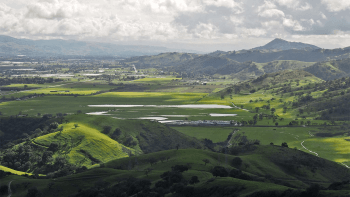
Coyote Valley is a scenic landscape that sits between San José and Morgan Hill
Coyote Valley is one of the state’s highest‑priority conservation areas, repeatedly cited by the California Natural Resources Agency as a model for 30x30 because of its:
-
Nature-based solutions that build climate resilience against wildfires, drought, flooding, and other extreme weather.
-
Connected, protected wildlife corridors
-
Groundwater recharge functions
-
Healthy agricultural soils
-
Proximity to millions of Bay Area residents
The 17,200‑acre Coyote Valley Conservation Program Area, established by the state in 2019, connects more than 1.1 million acres of habitat between the Santa Cruz Mountains and the Diablo Range.
More than 1,600 acres of rare valley‑floor ecosystem are now protected, supporting climate resilience, wildlife movement, groundwater recharge, farmland, scenic open space and outdoor recreation.

Illustration of a wildlife crossing, courtesy of Peninsula Open Space Trust.
A Model for the Future
This agreement is a model for how California can meet its energy needs without compromising the natural systems that sustain us.
By choosing collaboration over conflict, and innovation over impact, the Open Space Authority, PG&E, and LS Power Grid California have shown that we don’t have to choose between reliable power and a healthy environment.
This piece of prime farmland in Coyote Valley remains undeveloped. Silicon Valley gets the energy capacity it needs. And California gains a blueprint for building the infrastructure of the future in a way that honors the landscapes we all depend on.
Related Posts


