
Board of Directors Unanimously Opposes Proposed AES “Jewelflower” Battery Storage Project in Coyote Valley
Public Board Meeting May 28, 2026
During a public meeting on May 28, the Santa Clara Valley Open Space Authority Board of Directors voted unanimously to oppose the proposed AES Jewelflower Battery Energy Storage System. If approved, the project would place hundreds of containerized lithium‑ion battery units across roughly 40 acres of prime farmland in North Coyote Valley.
“This project is simply in the wrong place,” said the Authority Board Chair, Kathy Sutherland. “Installing an industrial battery facility in the middle of this conserved landscape will undermine everything done by residents of Santa Clara Valley to protect Coyote Valley.”
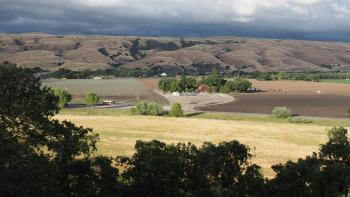
View from North Coyote Valley Hill: What is now prime, actively farmed land is being considered as the site for the proposed AES Jewelflower Battery Energy Storage System.
Quick background: The proposed industrial‑scale project would sit surrounded by protected open space lands which voters and public agencies have invested more than $160 million to conserve for wildlife movement, groundwater recharge, climate resilience, sustainable agriculture and public access. It would also lie within the Coyote Valley Conservation Program area designated in State statute by AB 948 (Kalra, 2019) identifying Coyote Valley as a landscape of statewide significance. (Please scroll to the bottom of this page for more resources and information.)
Why Location Matters: “We are supportive of renewable energy and storage,” said Andrea Mackenzie, General Manager of the Authority. “But these projects must be sited responsibly and respectfully, given the significant public investment in Coyote Valley. We can’t sacrifice irreplaceable natural and agricultural lands when alternative sites for the project exist.”
In recent presentations to the Authority Board of Directors and Citizens’ Advisory Committee, Authority staff explained that a previous battery‑storage project – known as the Hummingbird project - was successfully relocated from open space to a more suitable site. The new location sits directly behind the Open Space Authority’s headquarters in San José, an area already zoned for industrial use and far from sensitive wildlife habitat.
“The Authority’s understanding is that the project would not be addressing a local need, as the stored energy would likely serve projects like data centers in other parts of the state, including southern California,” said Marc Landgraf, Assistant General Manager, who has been delivering updates on the project to the Board. "In contrast, the natural and agricultural lands of Coyote Valley currently provide place-based critical ecological and local and regional climate benefits to the community, including flood protection, wildlife connectivity and groundwater recharge.”
Community Voices and State Leaders Speak Out: Members of the public and local environmental groups echoed these concerns through public comments. In the days leading up to the vote, the Authority’s Board of Directors received letters from parents whose children attend the charter school located directly across from the proposed project site. Many urged the Board to adopt the resolution, citing concerns about placing a large‑scale industrial battery installation so close to the school’s campus.
State elected officials, including Senator Dave Cortese and Assemblymembers Ash Kalra and Gail Pellerin also expressed concerns through letters submitted to the California Energy Commission (CEC). The CEC is the lead agency under Assembly Bill 205, which allows large energy projects—including utility-scale battery storage—to apply for (“opt into”) permitting through the CEC instead of going through local approvals.
Next steps:
- The Open Space Authority Board resolution will be submitted to the CEC as part of the public review process for the AES Jewelflower proposal.
- Authority staff will continue to monitor the battery storage proposal application to the CEC and provide regular updates to the Authority Board of Directors during regular public meetings.
Resources: For questions about the Open Space Authority's work to oppose the proposed AES Jewelflower Battery Energy Storage System, please contact us info@openspaceauthority.org or view the resources below for additional information:
Related Posts


