PRESS RELEASE: Santa Clara Valley Open Space Authority Board Adopts Resolution Opposing Proposed Heritage Oaks Cemetery in Coyote Valley
San José, Calif. (Sept. 25, 2026) – The Board of Directors of the Santa Clara Valley Open Space Authority (Authority) adopted a resolution formally opposing the proposed Heritage Oaks Memorial Park, a 102-acre cemetery, crematory and funeral complex planned for the hillsides above Coyote Valley in south San José.
The resolution passed unanimously and directs Authority staff to communicate the Board's position to the City of San José, to continue submitting comments on the project's environmental review and to pursue available options to oppose approval of the project as proposed in Coyote Valley.
Despite the proposed project site’s current General Plan designation as Open Hillside, the approval of a Planned Development zoning overlay from 2014 allows the development of new cemetery uses. While the City conducted environmental review for the project in 2014, there have been significant changes to the project since then, including the addition of a crematory, the extension of potable water outside of existing service areas and the construction of a recycled water pipeline. The current project, submitted in 2022, would implement the first two phases of the project across 41 acres with full buildout of 150,000 burial plots across the 102 acres.
As currently proposed, the project now includes a substantial amount of built infrastructure: a crematory, two-story funeral home and chapel, up to eight mausoleums, roughly 2 miles of internal roads, 124 parking spaces, grading that would cut into scenic ridgelines and knolls and a new multi-mile recycled water pipeline all within the state-designated Coyote Valley Conservation Area.
An Irreplaceable Landscape
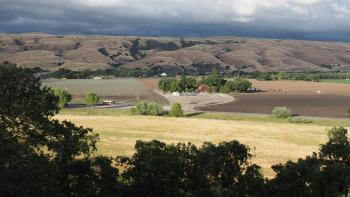
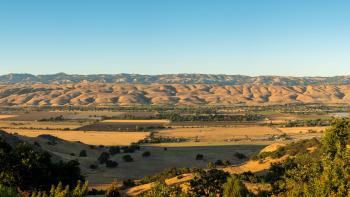
The Authority's opposition centers on the site's location within Coyote Valley, the agency’s top conservation priority and one of the most significant wildlife movement corridors in Central California. The Coyote Valley landscape protects regional groundwater supplies, reduces downstream flood risk, supports climate resilience and supports working agricultural lands that grow local produce and buffer communities from extreme weather.
Coyote Valley is also the last remaining undeveloped landscape linkage connecting the Santa Cruz Mountains to the Diablo Range, the natural and working lands that allow wildlife to move between over 1 million acres of core habitat in the two ranges. Scientists have identified that connection as essential to the long-term survival of mountain lions, bobcats, badgers and dozens of other native species. Its essential role in protecting the region’s biodiversity is why the valley is often described as a "last chance landscape": once the linkage is broken, it cannot be rebuilt.
Directly adjacent to the proposed Heritage Oaks project site is the Authority’s 348-acre Coyote Valley Open Space Preserve which was permanently protected in 2010 and opened to the public in 2015. In the decade since, working in partnership with the Peninsula Open Space Trust and the City of San José, the Authority has helped acquire 1,700 acres in Coyote Valley, now the Coyote Valley Conservation Areas, with funding from the Authority's Measure Q, San José's Measure T and POST, and supported by multiple state and local agencies. Over $160 million has been invested to date in conservation of the Coyote Valley. The project’s proposed ridgeline grading, building lighting, road networks, multi-story structures and industrial uses would permanently fragment habitat and introduce extensive development in an area surrounded by thousands of acres of publicly protected open space critical to wildlife movement.
The Authority is working closely with the Peninsula Open Space Trust and the City of San José to complete the Coyote Valley Conservation Areas Master Plan, to design and implement restoration of water resources, wildlife movement corridors, agriculture and public access trails on the 1,700 acres of protected open space lands that surround the proposed cemetery site. The Plan is expected to be completed in 2027.
"Once nature is developed, it’s gone forever," said Kathy Sutherland, chair of the Santa Clara Valley Open Space Authority Board of Directors. "Coyote Valley is an essential lifeline for local wildlife, and Santa Clara County’s voters and taxpayers have invested tens of millions of dollars to safeguard it for the benefit of everyone. Our board has a responsibility to speak up when development proposals undermine that work."
Analysis finds no shortage of burial capacity
The board's action also responds to findings from an independent market assessment report commissioned by the Authority of the proposed cemetery prepared by Silicon Valley Synergy, which examined burial demand, existing supply and long-term financial durability across the regional deathcare market.
The assessment concluded that the greater Bay Area, including Santa Clara County, faces no demonstrated shortage of burial capacity. Among its findings:
- Undeveloped land inside Santa Clara County's existing, already-permitted cemeteries could supply an estimated 75 to 146 years of burial capacity, before counting cemeteries in San Mateo, Alameda or Santa Cruz counties.
- At a standard market capture assumption, the roughly 150,000 plots proposed at Heritage Oaks would represent centuries of inventory, while California's rate of traditional ground burial is projected to fall to roughly 11%of dispositions by 2045 as cremation and lower-impact alternatives continue to grow.
- Burial activity at Oak Hill Memorial Park, the San José cemetery owned and operated by the same company developing Heritage Oaks, declined 22.5% between 2021 and 2025, from 1,300 burials to 1,007, according to filings with the California Department of Consumer Affairs.
- An active secondary market in previously purchased plots, resold at discounts commonly ranging from 20% to 80% below retail, is adding supply to the region with no new land conversion at all.
- Due to the recent passage of new state bills, local governments are now increasingly responsible for cemeteries that are abandoned due to underperformance or other reasons.
"Every community needs to thoughtfully plan for its future needs," said Andrea Mackenzie, general manager of the Santa Clara Valley Open Space Authority. "The data shows there is no shortage of burial or cremation capacity in the region and that existing cemeteries have ample capacity for generations to come. Knowing this, the significant environmental trade-offs that the Heritage Oaks project would require cannot be mitigated or justified. We have a responsibility to protect the integrity of the Coyote Valley Conservation Program Area and its last remaining wildlife movement corridors that the public has so significantly invested in."
Next Steps
The City of San José Planning Department is preparing the Final Supplemental Environmental Impact Report. According to city policy, if staff determine that there are no new significant and unavoidable impacts since the project was evaluated in 2014, then the project would go to a planning director’s hearing for approval. If a planning director decision is appealed, it must be redirected to a hearing of the Planning Commission and then the City Council.
The full resolution is available at https://www.openspaceauthority.org/public-meetings
More information about the Authority's work in Coyote Valley is available at https://www.openspaceauthority.org/projects-programs/coyote-valley-master-plan/about-coyote-valley
* * *
About the Santa Clara Valley Open Space Authority
The Santa Clara Valley Open Space Authority conserves the natural environment, supports agriculture, and connects people to nature, by protecting open spaces, natural areas, and working farms and ranches for future generations. Since 1993, the Authority has protected almost 30,000 acres of open space, natural areas and working lands, watersheds, and wildlife habitat – providing ecologically friendly outdoor recreation and preserving the natural beauty and environmental health of the Santa Clara Valley. For more information, visit openspaceauthority.org.
# # #
Related Posts