The Adventures of a Raindrop in Santa Clara Valley
Clean water is essential for every living thing. That’s why the Open Space Authority works to protect and maintain the network of ponds, streams, creeks and reservoirs that make up Santa Clara Valley’s water system. Let’s learn about the local water system, starting with a quick glance of the “Water Cycle.”
About the Water Cycle
Rain or "Precipitation" falls from clouds that hover above Coyote Valley Open Space Preserve.
The “Water Cycle” provides a simple explanation for how water naturally flows throughout the environment. It includes four primary phases: evaporation, condensation, precipitation and collection, through which water transforms from a liquid to a gas and then a solid state.
Evaporation takes place when water (specifically water on the surface layer of bodies of water, or snow or ice) turns into vapor, or steam, due to an increase in temperature. Once vapor enters the atmosphere, it turns into liquid droplets that float in the air – this process is known as “condensation.” When these small water droplets or vapor within the air collide with tiny particles of dust or salt, they condense and bind together to create a cloud. As particle collisions increase, a water droplet (or multiple!) forms and falls from the cloud as a raindrop. When a cloud becomes too heavy to contain the droplets, water falls from the cloud in the form of rain (or snow, depending on the temperature) and enters the “collection” phase of the water cycle. Here, a raindrop may land in a stream, creek or other body of water or soak into the ground.
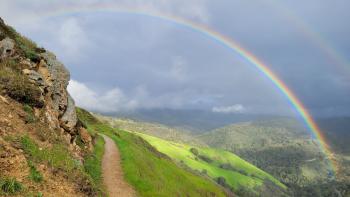
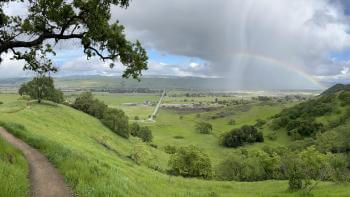
A double rainbow appears to arch over Sierra Vista Open Space Preserve after a rainstorm.
In the "collection" phase, a raindrop* will do one of four things:
- Seep into the top layer of soil or fall directly onto a plant, which helps our native plants and crops grow!
- Seep into the deeper layers of rock beneath the soil. In Santa Clara Valley, the rocky layers beneath the soil create an “aquifer” which holds onto water, similarly to how a sponge soaks up water.
- Evaporate back into the atmosphere – cue the “Evaporation” phase! When liquid water rises in temperature, it can transform into a gas-like state and moves from the surface of the Earth’s atmosphere to the air.
- Trickle into a nearby stream or other body of water.
*Alternatively, if snow falls, it either immediately or eventually melts into water – also known as snowmelt.
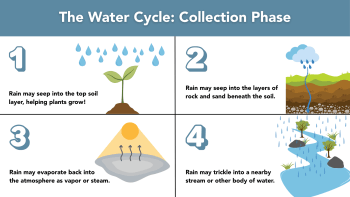
The Water Cycle in Santa Clara Valley
Every place on Earth experiences the four phases of the water cycle. But for the purposes of explaining the way water moves throughout Santa Clara Valley lands, we’ll focus our attention on two of the phases: precipitation and collection. During the winter, the Santa Clara Valley typically experiences a handful of storms that may produce two to three inches of rain each month. After the rain falls, it enters the “collection” phase of the water cycle.
When a raindrop falls onto the soil and seeps into the layers of rock beneath it, it may end up in an aquifer! Let’s learn about aquifers and their benefits:
Aquifers
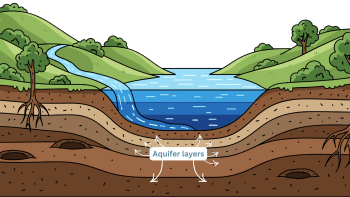
An aquifer consists of rocks, sands and tiny soil particles like silts and clays – anything that holds some water. When rainwater falls to the ground, it filters down into the soil and through layers of the aquifer where it is stored underground. Eventually, it may be used by plants or by humans when it is extracted from the ground for our water supply. Aquifers provide additional benefits, including:
- Filtering water through fine soil particles to improve water quality.
- Storing water which can later be used for agriculture, industrial and human needs.
- Slowing the release of water into our streams during the drier months, thus sustaining all plants and wildlife that depend on our streams.
Santa Clara Valley Aquifers
In Santa Clara Valley, rainwater that falls to the ground and soaks into the aquifer layers is a critical water resource for residents. According to the Santa Clara Valley Water District, nearly half of the water used by community members is pumped from groundwater. But it’s important to note that we would run out of water if we relied only on rainwater that seeps directly into the aquifers. The aquifer’s water supply is refilled by the controlled release of rainwater that fills up our reservoirs. This rainwater comes from local watersheds as well as imported water from the Sierras via the Central Valley. The term “watershed” is frequently used, but what does it mean?
Watersheds
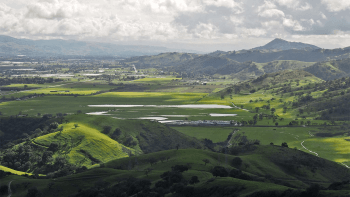
Rainwater falls onto the the mountains and hillsides that surround Coyote Valley and trickles down into the creeks and rivers below. This area is known as a watershed.
When a raindrop falls to the Earth and drains to a common area or flows to a single point, it is gathering in a watershed. According to the USGS, a watershed is sometimes referred to as a “catchment” because it catches rainfall in one area. Watersheds are complex due to their broad definition – a watershed can be as small as a piece of paper or millions of square miles (think: the Mississippi River). Watersheds are also like nesting dolls – one watershed may fit inside a larger watershed, which fits into an even larger watershed, and so on.
Watersheds are an important piece of the water cycle and naturally guide, store and treat water. For example, watersheds naturally filter pollutants from rainwater, making clean water easily accessible to wildlife and decreasing the need for humans to depend on expensive equipment to clean the water that enters human-made water systems.
Santa Clara Valley Watersheds
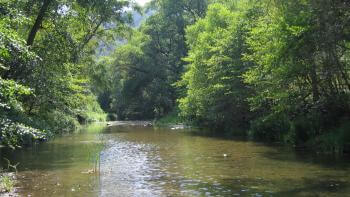
In Santa Clara Valley, there are five major watersheds: Coyote, Guadalupe, Lower Peninsula, Uvas-Llagas and West Valley Watersheds. Each watershed is made up of rivers, creeks and, sometimes, reservoirs and wetlands. More than 800 miles of creeks and rivers wind through the Valley’s urban and open space, making it a lush and biodiverse region. A raindrop that lands in a Santa Clara Valley creek will likely continue to flow downstream towards the San Francisco Bay. However, if the raindrop lands in the Pajaro River (and other places in the South County) and its connecting creeks, it will likely end up in Monterey Bay.
If the raindrop lands in a reservoir, its journey may be temporarily paused.
Reservoirs
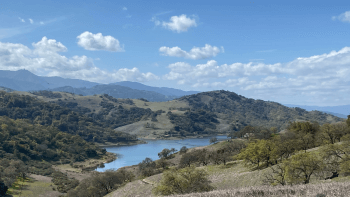
Calero Reservoir in Santa Clara Valley
When a raindrop lands in one of the 11 local reservoirs, it may await treatment to become clean, usable water for Santa Clara Valley residents. A reservoir consists of a man-made dam, or concrete block, that prohibits gathered rainwater or snowmelt from flowing through its natural course and controls when the water is released. Storing rainwater in a reservoir can help prevent floods in nearby communities and retain a hearty supply of drinking water for future use. If the raindrop does not become drinking water for humans, it will eventually be released and once again flow downstream.
Alternatively, a raindrop may fall into a natural body of water, like a wetland.
Wetlands
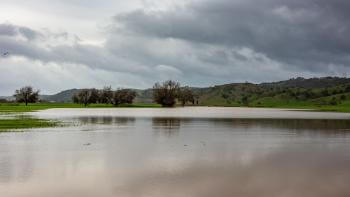
Laguna Seca Wetland
If a raindrop ends its journey in a wetland, it becomes part of a unique body of water that benefits both humans and wildlife. A wetland is land that is covered by water, or soil that is heavily hydrated, either permanently or on a temporary and seasonal basis. Wetlands offer habitat for migratory birds and threatened aquatic species, like the California tiger salamander, California red-legged frog and Northwestern pond turtle.
Known as “nature’s kidneys,” wetlands also filter debris and toxins from the rainwater, creating clean water for local wildlife. In Santa Clara Valley, the historic Laguna Seca wetland fills up with rainwater during the wet season and typically dries up during the summer months. The wetland acts as a resting spot for many species of migratory birds who travel through the region via the Pacific Flyway, a migratory path for birds that stretches from Alaska in North America to Patagonia in South America.
Floodplains
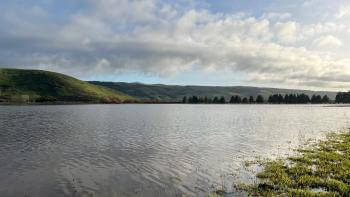
The Laguna Seca Wetland acts like a sponge and stores rainwater during the winter, preventing flooding in downstream communities.
One of the distinct benefits of Laguna Seca is that it sits within a floodplain, or an area of land that lies next to a river or other body of water and fills with rainwater when the body of water overflows.
The 2,500-acre floodplain that surrounds Laguna Seca is the last undeveloped floodplain in the South Bay and provides many natural benefits to the surrounding Santa Clara Valley community. When it rains in Coyote Valley, rainwater may fall into Laguna Seca, nearby Fisher Creek and the surrounding floodplain. If the region experiences heavy rains, the floodplain acts as a sponge and holds onto spillover from the wetland and creeks, helping to reduce the likelihood that residents in communities throughout San José who live next to the long, winding creek will experience damaging flood impacts. Floodplains also play an important role in creating healthy habitat for local wildlife and can even boost local agriculture by supplying rich and fertile soil.
Once a storm passes, the water within streams and creeks will begin to decrease. As a result, the floodwater that once spilled over into the floodplain will empty back into the creeks and streams, allowing the raindrop to continue its journey downstream toward a larger body of water.
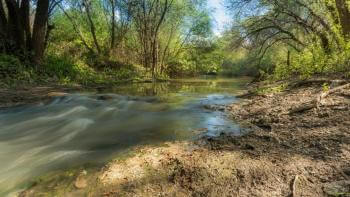
Water flows down the Pajaro River toward Monterey Bay
Whew, raindrops that land in the Santa Clara Valley adventure through a variety of landscapes and bodies of water! Once a raindrop makes its way back to a bay or ocean, it will likely become evaporation, following its natural rhythm and continuing its perpetual journey in the water cycle.
Protecting Water Resources in Santa Clara Valley
At the Open Space Authority, understanding how rainwater moves through open space and your preserves helps us to better protect sensitive species, restore watersheds and maintain clean water for generations into the future. Learn more about the Authority’s work to protect water resources by clicking here, here and here.
Related Posts