Growth and Green Space: Can We Have Both?
Growth and conservation aren’t competing priorities, they’re pieces of the same puzzle. When elected officials, developers, public agencies – like the Open Space Authority – and community members work together to decide how local land should be used, we can meet growing housing, energy and other development needs while also preserving open space for the benefit of people, wildlife and the environment.
What's At Risk

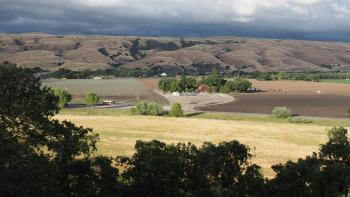
Photo by Derek Neumann.
Healthy lands and open space play a key role in maintaining a thriving Santa Clara Valley. However, when land or open space is mischaracterized as vacant or underutilized, developers often see an opportunity to add value to the land. If a development project location is decided without early coordination, we run the risk of negatively impacting people, wildlife and land in ways that are irreversible. A few examples:
- People: A community that depends on open land as a wildfire buffer suddenly has one less line of defense. A family farm loses its access to water that it's relied on for generations. A future hiking trail disappears behind a fence.
- Wildlife: A new project development interrupts a mountain lion's migration corridor, forcing it into closer contact with roads and neighborhoods. Ground-nesting birds lose the undisturbed grassland they need to raise their young.
- Land: A farm that fed the local community for decades becomes a distribution center. A wetland that naturally filtered water and prevented flooding in residential neighborhoods is gone.
Minimizing Tradeoffs and Maximizing Benefits

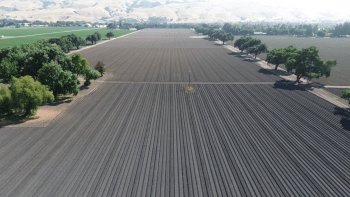
Photo by Annamarie Pilon
Whether these trade-offs are avoidable often comes down to when the full range of local voices, including public agencies like the Open Space Authority and other members of the public, enter the process. Under state law, most projects are required to offer opportunities for public engagement during the environmental review process. But these opportunities often happen after projects are well underway, at which point it is more costly and complicated to make changes.
We can be a lot more productive and cost-effective if there are diverse perspectives at the table from the start. It’s hard – and sometimes impossible – to change or undo a project, so it’s best to have a transparent process from the start that is informed by a holistic vision that the community has already had a say in.
While early engagement and collaboration can be challenging, the Open Space Authority has demonstrated how it is possible. In early 2026, LS Power Grid California (LS Power) considered locations for a new high-voltage converter station to meet the growing energy needs of Santa Clara Valley. At first, LS Power considered buying and developing over a 14-acre orchard in Coyote Valley. Located between Monterey Road and US 101 in Morgan Hill, the site is part of one of the few safe wildlife corridors in the valley. Once the Open Space Authority learned of the proposal, we had the opportunity to demonstrate to LS Power how the proposed development would degrade the conservation investments made in Coyote Valley for public benefit.

Elected officials stand with representatives from LS Power Grid California, Santa Clara Valley Open Space Authority, and PG&E site with the existing PG&E facility in the background. Photo by David Mauk
Together, the Open Space Authority and LS Power explored alternative locations for the project that would provide more benefits with fewer tradeoffs. In the end, LS Power worked with PG&E to locate the new station on an already developed PG&E property right down the road, saving costs for the developer and preventing the unnecessary loss of prime farmland in a precious wildlife corridor.
“This agreement demonstrates how smart planning and collaboration can deliver critical energy solutions while preserving conservation landscapes,” said Casey Carroll, senior vice president of LS Power Grid California, in a press release to announce the decision to place LS Power’s station at the PG&E Metcalf substation.
The Importance of Carefully Crafted Policy
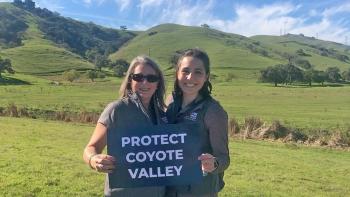
Lena Drape, Conservation Policy Specialist for the Open Space Authority, holds a sign that reads "Protect Coyote Valley."
Beneath this important community and stakeholder engagement are the foundational local, state, and federal policies that determine where certain development is allowed.
This is where Lena Drape’s role comes into play. As a Conservation Policy Specialist, Lena monitors new local, state and federal policy proposals and considers how they could impact the people, land and wildlife that lie within the Open Space Authority’s jurisdiction. Lena also supports the team of Open Space Authority staff who monitor and review new development proposals. Together, they assess each project’s potential opportunities and impacts, relative to the Open Space Authority’s mission.
For each proposed project, the team asks the questions: why is this project being proposed, how does it benefit the community and what potential benefits will be lost if the project moves forward? Part of Lena’s role is to consider each project through the lens of current and potential future policy. “Policy is constantly changing, and sometimes well-intended policies can have unintended consequences that we do not realize until they are already in action.”
The Open Space Authority looks forward to collaborating with partners to meet the growing housing and energy needs of the region.
We want to continue supporting projects that offer multiple benefits to the Santa Clara Valley community. We are taking what we learned through our collaborative experience with LS Power and PG&E into conversations with our partners and policymakers about how to improve local, state, and federal policy for stronger outcomes.
Planning Together for What's Next

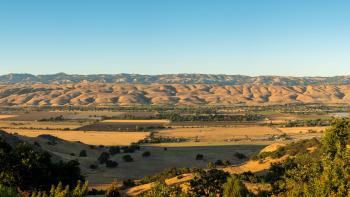
Photo by Derek Neumann
Policy and land use may get tricky at times, but one thing is clear: early and collaborative discussions about what we do with the land are necessary to address our region’s growing needs. “We know that once we pave over these lands, they are forever changed, and the myriad benefits they provide are permanently lost,” Lena said. “But if many of these projects are needed – which they are – then being a modern conservation partner means helping to support the future of both our protected and developed lands, for the benefit of current and future generations.”
Learn how the Open Space Authority is protecting open space here.
Related Articles: Where Protecting Coyote Valley and Powering the Future Align; Board of Directors Unanimously Opposes Proposed AES “Jewelflower” Battery Storage Project in Coyote Valley; From our partner, Silicon Valley Youth Climate Action: The Climate Solution We're Overlooking Starts at Home
Related Posts