Ladybugs Photo
Nature

The green growing world outside our windows is an incredibly diverse landscape of different plant species. It’s estimated that over 350,000 different kinds of plants exist worldwide.

Many hundreds of trees, shrubs, wildflowers and grasses populate OSA lands. They grow in recognizable groupings, or plant communities, that help distinguish one area from another. The most common plant communities found on OSA lands are chaparral, oak woodland, grassland, riparian and serpentine grassland.

The types of plants that thrive in a given location offer clues to the elevation, soil types, water availability, sun exposure and other resources available there. Being acquainted with plants can help you read the larger patterns of the natural world.

Now showing on OSA lands

Mugwort
Mayfair Ranch Trail
Rancho Cañada del Oro Open Space Preserve

mugwort photo

Mugwort is a tall plant that is widely distributed throughout the state, favoring woodlands, grasslands and chaparral, especially where there is moisture. This California native is also found in other western states and thrives in disturbed soils.

Mugwort leaves contain camphor and other oils, which give off an aromatic sage smell. Some people claim that rubbing mugwort on your skin will counteract the effects of poison oak. Native Americans used the plant to treat wounds, rheumatism, earache, asthma and many other ailments. It was also thought to ward off ghosts.

Scientific Name: Artemisia douglasiana
How to say it: ar-tem-EE-see-a dug-las-ee-AY-na


Tall Stephanomeria
Mayfair Ranch Trail
Rancho Cañada del Oro Open Space Preserve

stephanomeria photo

This plant is considered to be a weed and is often found in disturbed places. It is common to woodlands, grasslands and many other plant communities as well as on dry open slopes. Stephanomeria, which is also known as tall milk aster, can grow to a height of 7 feet. The milky juice of the plant was used by some Native Americans as an eye medicine.

Scientific Name: Stephanomeria virgata ssp. pleurocarpa
How to say it: stef-an-oh-MEER-ee-a vir-GAY-ta plur-oh-KAR-pa


Sticky Rosinweed
Mayfair Ranch Trail
Rancho Cañada del Oro Open Space Preserve

rosinweed photo

Sticky rosinweed is a plant that’s well adapted to serpentine soils. It’s a California native, most often found in the central counties, that occurs naturally only within the state. Rosinweed bears flowers that are white, cream or rose, on densely packed stalked interspersed among hairy leaves that, when crushed, give off a smell like pine.

Scientific Name: Calycadenia multiglandulosa
How to say it: kal-i-ka-DEN-ee-a mul-tee-gland-yoo-LO-sa


Common Hareleaf
Mayfair Ranch Trail
Rancho Cañada del Oro Open Space Preserve

fuchsia photo

Common or branched hareleaf is a native California annual that also grows in other western states. A member of the sunflower family, hareleaf is widely distributed in the state where it favors woodland, chaparral and grassland terrain. The plant gets its names, both common and scientific, from the soft, furry covering on the leaves of the first lagophylla identified: lago is Greek for hare, an animal known for its silky fur.

Scientific Name: Lagophylla ramossisima
How to say it: lag-oh-FIL-a ra-mo-SI-si-ma


Hayfield Tarweed
Mayfair Ranch Trail
Rancho Cañada del Oro Open Space Preserve

tarweed photo

Like all tarweeds, this plant has sticky, heavily scented leaves. Since it blooms in summer, tarweed relies on stored soil moisture and has evolved a deep taproot to survive the seasonal heat and drought. This annual herb is found in grassland, woodland and scrub plant communities. It's a member of the sunflower family. A California native, hayfield tarweed is also found in other western states.

Scientific Name: Hemizonia congesta
How to say it: hem-ih-ZONE-ee-a kon-JES-ta


Spiny Redberry
Mayfair Ranch Trail
Rancho Cañada del Oro Open Space Preserve

redberry photo

Sometimes called redberry buckthorn (rhamnus is an old Greek word meaning buckthorn), this California native gets its common name from a very obvious feature. The berries are edible and were used as a food source by some Native Americans. Redberry favors sage scrub, chaparral, woodland and forest environments. In its southern-most distribution, San Diego County and Baja California, this small evergreen shrub is a larval host to the rare Hermes copper butterfly.

Scientific Name: Rhamnus crocea
How to say it: RAM-nus kro-see-a


Harding Grass
Mayfair Ranch Trail
Rancho Cañada del Oro Open Space Preserve

Harding grass photo

Harding grass was introduced to the United States as a forage plant that could withstand dry conditions and heavy grazing. It has spread into natural habitats where it can outcompete native grass species, forming large, dense bushes. Harding grass is now found in much of California, particularly coastal valleys and foothills, and also in a number of other states. It is native to the Mediterranean region.

Scientific Name: Phalaris aquatica
How to say it: fa-LARE-is a-KWA-ti-ka


Kellogg’s Yampah
Mayfair Ranch Trail
Rancho Cañada del Oro Open Space Preserve

yampah photo

A California native, Kellogg’s yampah occurs naturally only within the state, where it is found mostly in the northern and central counties. The plant’s dense heads of small flowers grow on long slender talks that can often be 3 or 4 feet tall. When crushed, the plant’s leaves smell a bit like rootbeer.

Yampah is a larval food source for the anise swallowtail butterfly. Native Americans ate the thick fibrous root and young greens and also had medicinal uses for the plant. Kellogg’s yampah is named for Dr. Albert Kellogg, a 19th-century California physician and botanist. He was an early supporter of women’s participation in the sciences.

Scientific Name: Perideridia kelloggii
How to say it: per-id-er-ID-ee-a kel-OG-ee-eye


Farewell to Spring
Mayfair Ranch Trail
Rancho Cañada del Oro Open Space Preserve

farewell to spring photo

Farewell to spring, a California native, is also called ruby chalice clarkia because of the color and cup shape of its blossoms. The plant is often found in large dense stands, particularly on open grassy hillsides. The plant occurs naturally only in California, primarily in the coastal counties in the central part of the state.

Scientific Name: Clarkia rubicunda
How to say it: KLAR-kee-a roo-bi-KUN-da


Toyon
Mayfair Ranch Trail
Rancho Cañada del Oro Open Space Preserve

toyon flowers photo

Toyon is a California native that is green all year. In late spring or early summer it has showy clusters of tiny white flowers. In winter this shrub’s bright red berries and dark green leaves give the slopes a holiday look. Their appearance explains why toyon is sometimes called Christmas berry or California holly. Birds flock to the berries. Coyotes also eat them. Straight off the bush they taste bitter and astringent to humans, but Native Americans dried or roasted them for cooking.

Scientific Name: Heteromeles arbutifolia
How to say it: het-er-oh-ME-leez ar-boo-tih-FOE-lee-ah)


Iris-Leaved Rush
Longwall Canyon Trail
Rancho Cañada del Oro Open Space Preserve

iris-leaved rush photo

This rush is a California native also found in other southwestern states. It is a perennial that grows in forest, woodland, chaparral and grassland environments, almost always in wetland conditions. Iris-leaved rush spreads by rhizomes (a structure like a bulb). It attracts birds and serves as a food source for the larvae of butterflies. One way to tell iris-leaved rush from other similar plants is to touch the leaves, which have air bubbles you can feel.

Scientific Name: Juncus xiphioides
How to say it: JUN-kus zif-ee-OH-i-dees


California Fuchsia
Mayfair Ranch Trail
Rancho Cañada del Oro Open Space Preserve

fuchsia photo

The showy blossoms of this shrubby plant produce nectar that is an important food source for hummingbirds. Another name for the fuchsia is hummingbird trumpet. A California native, this plant is also found in other western states. It's an evergreen perennial with distinctive silver-green foliage. Fuchsia blooms in late summer and fall.

Scientific Name: Epilobium canum
How to say it: ep-ih-LOH-bee-um KAN-um


Loma Prieta Hoita
Longwall Canyon Trail
Rancho Cañada del Oro Open Space Preserve

hoita photo

This California native, listed by the California Native Plant Society as a rare, threatened or endangered plant, is found only in a few places around the Bay Area, most of them in Santa Clara County. A legume in the pea family, Loma Prieta hoita is a good-sized shrub with large purple flowers on stalks. It favors openings in chaparral and woodland, often where soils remain moist into summer. The name hoita comes from a word in the Maidu language spoken by Native Americans in the north-central part of the state.

Scientific Name: Hoita strobilina
How to say it: ho-IT-ay stro-bil-EYE-na


Curly Dock
Llagas Meadow
Rancho Cañada del Oro Open Space Preserve

curly dock photo

Curly dock is an introduced plant, native to Europe, that grows everywhere in North America. Like many other plants brought to this continent by settlers, curly dock has a number of medicinal uses and was also used in dyeing. This dock produces extravagant numbers of seeds and spreads easily. It is listed as a weed by the California Invasive Plant Council, but of minor impact. The leaves of curly dock are considered to be edible, but the oxalic acid they contain, which gives them a sour lemony taste, might be toxic in large quantities.

Scientific Name: Rumex crispus
How to say it: ROO-mex KRIS-pus


California Everlasting
Mayfair Ranch Trail
Rancho Cañada del Oro Open Space Preserve

everlasting photo

This fragrant California native has tightly packed blossoms that are attractive fresh or dried. Everlasting is also found in other western states. The plant favors forest, woodland and chaparral environments and is widely distributed throughout the state. Some Native Americans had medicinal uses for the plant, and it is a food source for the larvae of painted lady butterflies.

Scientific Name: Gnaphalium californicum
How to say it: na-FAY-lee-um ka-li-FOR-ni-kum


Slender Wild Oat
Widespread
Rancho Cañada del Oro Open Space Preserve

wild oat photo

The tall shafts of the dried wild oat color the grasslands tawny gold this time of year. Wild oat is an invasive species, originally from the Mediterranean area of Europe and southwestern Asia. It was first introduced for livestock forage and, with its greedy appetite for spring soil moisture, was quickly able to out-compete native bunch grasses. It is now widespread in California and can be found in most western states. In an example of human adaptation, some Native Americans developed uses for the seeds, often boiling and mashing them into a soup or mush.

Scientific Name: Avena barbata
How to say it: a-VEE-na bar-BAY-ta


Doveweed or Turkey Mullein
Mayfair Ranch Trail
Rancho Cañada del Oro Open Space Preserve

doveweed photo

The seeds of this plant are a favored food source for both mourning doves and turkeys, which accounts for the two common names it's known by. A California native, doveweed grows on dry, sandy soil, often in disturbed areas. It is unpalatable to lifestock and is considered a weed in Australia, a reversal of the invasive plant migration we encounter. Doveweed was used in fishing by Native Americans and early Spanish settlers; another of its names is yerba del pescado. The plant, which has bristly leaves that give off a light spicy fragrance, also had a number of medicinal uses.

Scientific Name: Eremocarpus setigerus
How to say it: er-em-oh-KAR-pos seh-TI-jer-us


Chamise
Mayfair Ranch Trail
Rancho Cañada del Oro Open Space Preserve

chamise photo

A California native, chamise is a medium to large shrub common to chaparral plant communities, especially on dry slopes and ridges. Also called greasewood, it is quick to catch fire because of the highly flammable resins it contains. Chamise is also quick to resprout after a fire, sending up green shoots from its root crown. Native Americans had many uses for chamise: to make bows, arrows, baskets, ramadas and fences; to treat external wounds, and for firewood and torches.

Scientific Name: Adenostoma fasciculatum
How to say it: ad-en-OS-to-ma fa-sik-yoo-LAY-tum


Climbing Morning Glory
Longwall Canyon Trail
Rancho Cañada del Oro Open Space Preserve

morning glory  photo

This morning glory species with purple-tinged white blossoms is a California native found only in the state. It grows mostly in the central and northern coastal counties and inland valleys. A perennial vine that uses rocks, structures and other plants for support, climbing morning glory is also know as Pacific false bindweed.

Scientific name: Calystegia purpurata
How to say it: kal-i-STEE-jee-a pure-pure-AY-ta


Pipestem
Mayfair Ranch Trail
Rancho Cañada del Oro Open Space Preserve

pipestem photo

Pipestem is a climbing plant that can reach heights up to 20 feet or so, using shrubs and low trees for support. In spring the plant has creamy white flowers that open from round buds on long stems. Then the flowers develop into bursts of soft-looking filaments. Fluffy seed plumes dominate in winter as the leaves fall away.

A California native, pipestem is also found in other western states. Native Americans used the roots, bark or stems for cold remedies and pulverized charcoal derived from the plant to treat burns and other skin injuries.

Scientific name: Clematis lasiantha
How to say it: KLEM-at-is las-ee-AN-tha


Plant Communities

All plants live among other plants. Many factors determine how they group themselves. Elements like soil, water availability, slope, and elevation will draw some plants together and exclude others. Interactions among plant species and among vegetation and wildlife also play a part.

Plant communities often have soft edges where species overlap. And they change through time. Disturbances like fire and flooding can cause sudden, large alterations. A gradual evolution from one set of plants to another, called succession, can take decades or centuries to accomplish the same result.

With all the issues to consider, scientists have worked on defining plant associations for years. There are currently several naming systems that emphasize different concepts within the hierarchy of information about plants and plant relationships.

Our purpose here is descriptive, rather than analytical. We use broad terms to describe plant communities as they might appear to the interested visitor on OSA lands. The vegetation groupings most often encountered along the trail are chaparral, oak woodland, grassland, riparian, and serpentine grassland.


Chaparral
chaparral photo

Composed mostly of woody shrubs and small trees, chaparral is primarily a California landscape. Climate – hot dry summers and mild winters with little rain – is the largest influence on this community. Species that can adapt to drought and occasional fire thrive here.

The plants that make up a chaparral community may change from place to place, but the look is much the same: dense, low-growing evergreen bushes (often called brush or scrub) with little space for understory plants.

Reducing evaporation is key to surviving the intense summer heat of inland hillsides and mountain slopes where most chaparral grows. Plants have adapted by developing leaves that are small, thick and leathery. Some have waxy coatings or recessed water-releasing pores. Others align their leaves vertically to limit sun exposure.

They also have evolved fire-survival strategies. Many chaparral natives have deep root systems and will sprout new growth from the crown soon after fire destroys existing wood. Some species have seeds that lie dormant in the soil for years and germinate only after a fire.

Plants often found in chaparral communities include chamise, many species of manzanita and mountain lilac, buckwheat, scrub oak, coffeeberry and toyon.


Oak Woodland
oak woodland photo Several oak species grow on Authority lands, including live oak, blue oak and valley oak. The trees tend to follow an open pattern of distribution, with crowns touching but rarely overlapping. This spacing is implied in the use of the term woodland rather than forest.

The openness of oak woodland communities encourages several layers of associated species. Companion trees may include California bay, buckeye, madrone and California walnut. Common understory plants are blackberry, poison oak, blue elderberry, and some shrubs also found in chaparral, such as toyon and manzanita. On the ground, look for California poppies, lupine, miner’s lettuce and a variety of grasses.

Oak trees share some important characteristics that influence the plant communities clustered around them. A dual root system with a deep tap root and several layers of feeder roots helps draw moisture to the surface and is a boon to other plants.

Leaf litter accumulates from year to year, building a mulch that conserves moisture. It also provides a rich habitat for microorganisms that convert the inert matter to useful nutrients.

The abundant production of acorns attracts more wildlife to oak woodland communities than any other. Hundreds of bird, mammal, reptile and insect species form an intricate web of life, multiplying the food sources and enriching the plant environment.


Grassland
grassland photo California grasslands are perhaps the plant community most impacted by European settlement. The introduction of large grazing animals and imported feed set the stage for a transformation from perennial native bunch grasses to annual pasture grasses.

The natives, like purple needlegrass, adapt to high summer temperatures and limited rainfall by spreading across the landscape in clumps with open land among them. They also have extremely deep roots to draw on water reserves in the dry season. Through a conservative relationship to available water they are able to maintain a long-term growth strategy. Some individual native bunch-grass plants live for hundreds of years.

Annual grasses, by contrast, tell their whole story in one season. They put multiple shallow roots into the top few inches of spring-moist soil, grow like crazy (which cows appreciate), convert all their energy into copious seeds and then die, leaving behind a multitude of offspring to repeat the whole greedy cycle the following year.

Today most grasslands are dominated by the annuals: wild oats, ripgut brome, foxtail barley, ryegrass and others. The grasses may grow in open meadows or as the ground cover in woodlands. Creating openings for the re-establishment of native grasses and the small broad-leaved plants that grow with them, called forbs, is a high priority for the Open Space Authority.


Riparian
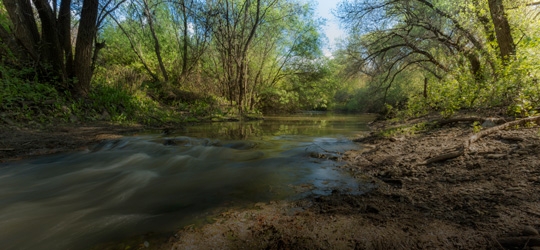
riparian photo Plants that grow along creeks and rivers (that’s what riparian means) are different in many respects from those that manage without a permanent source of water. Most noticeable are the tallest and largest trees, which lose their leaves in winter. The leaves themselves – large, soft and often broadly exposed to the sun – attest to the milder riparian conditions.

The leaf drop of these sycamores, cottonwoods and alders increases the winter sun available to a second tier of riparian plants. Younger willows, mulefat, blackberry, poison oak and other shrubs and vines often create a dense wall of foliage along creek and river banks. Sedges, rushes and cattails at the water’s edge add another habitat dimension.

Nonetheless, it’s the water itself that defines the environment. Variations in flow from drought to flood can drastically rearrange the structure of the water course. Despite fluctuations, however, the composition of the riparian plant community remains much the same, with key species returning even after massive floods.

It’s estimated that 50% of California’s birds, 40% of mammals and reptiles and 80% of amphibians in a given area will spend at least some part of their lives in a riparian environment. Many species of insects including dragonflies, beetles, butterflies and, of course, mosquitoes also thrive in this space where aquatic and land-based resources meet.


Serpentine Grassland
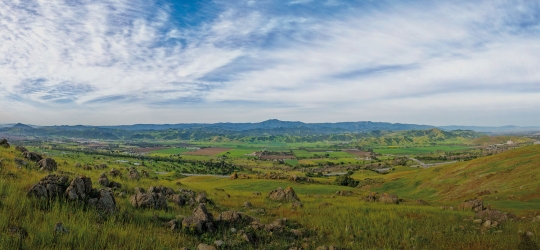
serpentine photo The defining factor of the serpentine grassland community is the soil. Serpentinite arises from the earth’s mantle along fault zones. Soils derived from the rock are rich in magnesium, low in calcium and include heavy metals such as chromium, nickel, and iron.

Nitrogen, potassium, and phosphorus (primary plant nutrients) may be scarce or absent. The soil, being shallow and rocky, holds water poorly and discourages deep root development. It also tends to erode easily.

This is not a welcoming environment. The influx of nonnative species that came to California along with European settlement couldn’t get much of a foothold. Areas of serpentine soils became a refuge for native plants that had adapted to the difficult conditions over many centuries.

Today serpentine soils cover less than 1.5% of California’s total area but support an estimated 10% of the state’s native plants. A number of special-status plants, including Tiburon paintbrush, Santa Clara Valley dudleya, Mount Hamilton thistle, most beautiful jewelflower and dwarf plantain, host plant of the endangered bay checkerspot butterfly, are found there.

Serpentine grasslands are known for their spectacular arrays of spring wildflowers. Multitudes of cream cups, goldfields, and California poppies, interlaced with popcorn flower, owl’s clover, morning glories and many others, paint the hillsides in brilliant color.